The tarot is often used to make “predictions about the future”. However, more than making predictions, it allows an unveiled look at the world and ourselves. After a while, we understand that, in fact, it “predicts” the only energy that exists: that of the present, which will influence future “presents”.
The tarot teaches us to live in the present, without spending too much energy reliving the past (an energy whose time has expired) or looking forward to the future (the next trip, the next day’s tasks). Life happens here and now. And on the present we must focus all our energy – and our love.
The tarot is a tool for self-knowledge and reflection about life and the world. It is a way of unlocking the secrets of our existence and the universe. It can help in the search for our personal mission. In more difficult times, it serves as a support, giving us a broader perspective on certain issues and helping us to see possible paths and favorable attitudes within the existing context.
The tarot can be used as a guide, a friend, a counselor. It is a tool that allows us to delve into our unconscious, to seek answers that are within us, but we cannot easily access. The cards help us to cross the barrier of consciousness and take us to the center of ourselves, where all the answers are.
The study of the cards, especially the Major Arcana, which represent the “Hero’s Journey” described by Joseph Campbell, gives us the vision that life is a great journey, comprising difficult and pleasant moments. The tarot makes us understand that life is made of cycles and every end is just a new beginning – a belief shared by various religions and spiritual and philosophical systems around the world.
Finally, the practice of reading cards can help us to strengthen our intuition and develop our spiritual nature.
I invite you to embark on this journey through the arcana, so that the magic of the tarot can be an instrument of personal evolution for you!
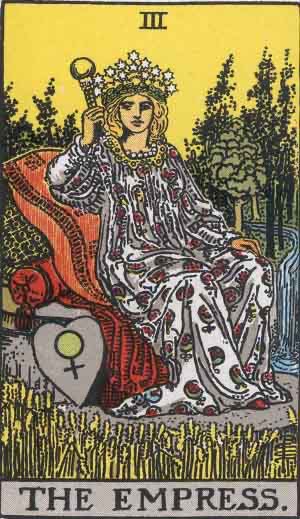
🏞 Image credit: “3 – The Empress”, Rider-Waite-Smith tarot, illustrated by Pamela Colman Smith in 1909.
 The Wheel of Tarot